
Legal Separation vs. Divorce in California Which is Right for Your Financial Future?
When a marriage reaches a breaking point, the path forward is rarely a straight line. For couples in California, the decision often boils down to two legal avenues: Dissolution of...
On this page Table of Contents 10 sections
- 1 1. Marital Status: The Legal Reality
- 2 2. The Residency Requirement Loophole
- 3 3. The “Health Insurance” Lifeline
- 4 4. Strategic Financial Planning: Social Security & Taxes
- 5 5. Community Property and the “Date of Separation”
- 6 6. Child Custody and Support
- 7 7. Religious and Personal Convictions
- 8 8. Timeline: The Waiting Period Factor
- 9 Comparison Summary: At a Glance
- 10 Choosing Your Path
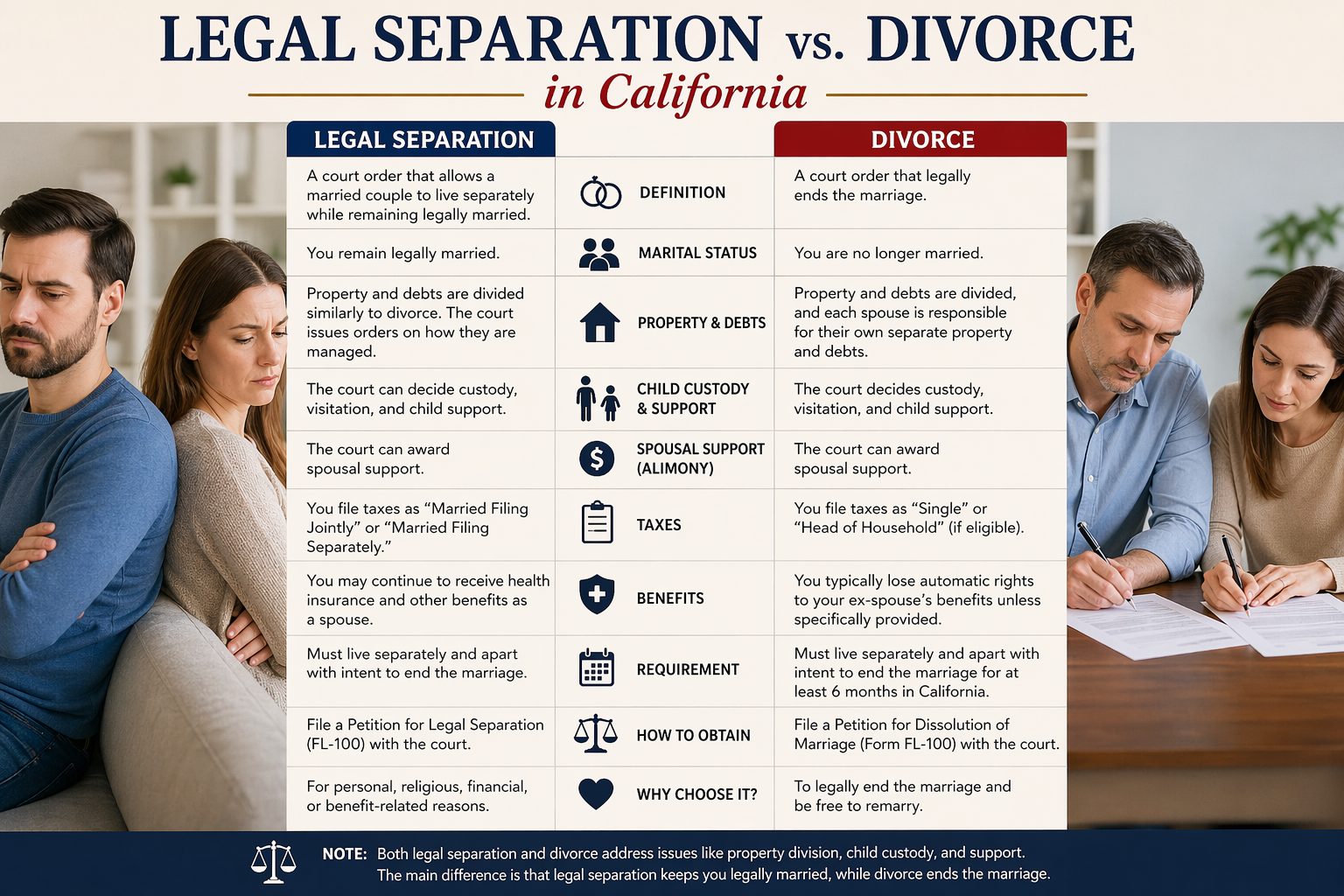
When a marriage reaches a breaking point, the path forward is rarely a straight line. For couples in California, the decision often boils down to two legal avenues: Dissolution of Marriage (Divorce) or Legal Separation.
While both processes involve legal filings and court orders regarding the division of your life, they lead to very different destinations—especially regarding your wallet and your legal status. Are you looking for a clean break to start over, or do you need to maintain a legal connection to protect your medical benefits?
In this comprehensive 1,500-word guide, we analyze the nuances of the California Family Code to help you determine which path aligns with your long-term goals.
1. Marital Status: The Legal Reality
The most fundamental distinction lies in your identity after the paperwork is signed.
- Divorce: A divorce legally ends the contract of marriage. Once the final judgment is entered, you are “Single.” You have the legal right to remarry and are no longer considered kin to your former spouse in the eyes of the law.
- Legal Separation: You remain legally married. While you live apart and your finances are separated by court order, you cannot remarry. In California, legal separation is a state of “legal limbo” that allows you to remain “Married” on paper while living independent lives.
2. The Residency Requirement Loophole
One of the most practical reasons Californians choose legal separation is the residency law.
To file for Divorce in California, at least one spouse must have lived in the state for six months and in the specific county of filing for three months. If you have recently moved to Los Angeles, San Diego, or Orange County, you might not meet this requirement yet.
Legal Separation has no residency requirement. This allows newcomers to file immediately to establish court orders for child support or custody. Once they hit the six-month mark of living in California, they can “amend” their filing to a divorce.
3. The “Health Insurance” Lifeline
For many, the decision is strictly financial. Most employer-sponsored health insurance plans automatically terminate coverage for a spouse the moment a divorce is finalized.
However, because a legally separated couple is still technically married, many insurance providers allow the non-employee spouse to remain on the plan.
Expert Tip: In 2026, many insurance companies have updated their policies. Always review your “Summary Plan Description” (SPD) with your attorney before assuming coverage will continue.
4. Strategic Financial Planning: Social Security & Taxes
The financial benefits of staying “legally married” but separated can be substantial, particularly for long-term marriages.
The 10-Year Rule for Social Security
Under federal law, if a marriage lasts at least 10 years, a lower-earning spouse can claim Social Security benefits based on the higher-earning spouse’s record. If you divorce at year nine, you lose this benefit. Legal separation allows the “clock” to keep ticking toward that 10-year milestone.
Tax Filing Status
Divorcees must file as “Single” or “Head of Household.” Legally separated couples may have the option to file “Married Filing Jointly” if their decree allows it. Depending on your income bracket, this can save thousands of dollars in annual tax liability.
5. Community Property and the “Date of Separation”
California is a Community Property state. This means that almost everything acquired from the date of marriage to the date of separation is owned 50/50 by both spouses.
The “Date of Separation” is a critical legal marker. Once you file for legal separation, the “community” ends. Any income you earn or assets you buy after this date are yours alone. Legal separation “locks in” this date officially, protecting you from being liable for your spouse’s new debts or having to share your future earnings.
6. Child Custody and Support
Regardless of whether you choose divorce or separation, the court applies the “Best Interests of the Child” standard.
- Child Support: Calculated using California’s statewide uniform guidelines (based on income and time spent with the child).
- Custody Schedules: Detailed plans for holidays, school weeks, and vacations are established in both processes.
- Spousal Support (Alimony): The court can order temporary or permanent support in both cases to ensure the lower-earning spouse can maintain their standard of living.
7. Religious and Personal Convictions
For some, the word “Divorce” carries a heavy social or religious stigma. Some religions do not recognize civil divorce or prohibit remarriage. Legal separation provides a “Middle Ground.” It allows the couple to settle their financial and parental obligations through the court system without technically violating their religious vows.
8. Timeline: The Waiting Period Factor
California law requires a six-month waiting period for a divorce to be finalized. Even if you agree on everything on day one, you are not “Single” until 180 days have passed.
Legal separation does not have a mandatory waiting period for the status to change. However, don’t be misled—negotiating complex assets like a family home or a business still takes months of legal work.
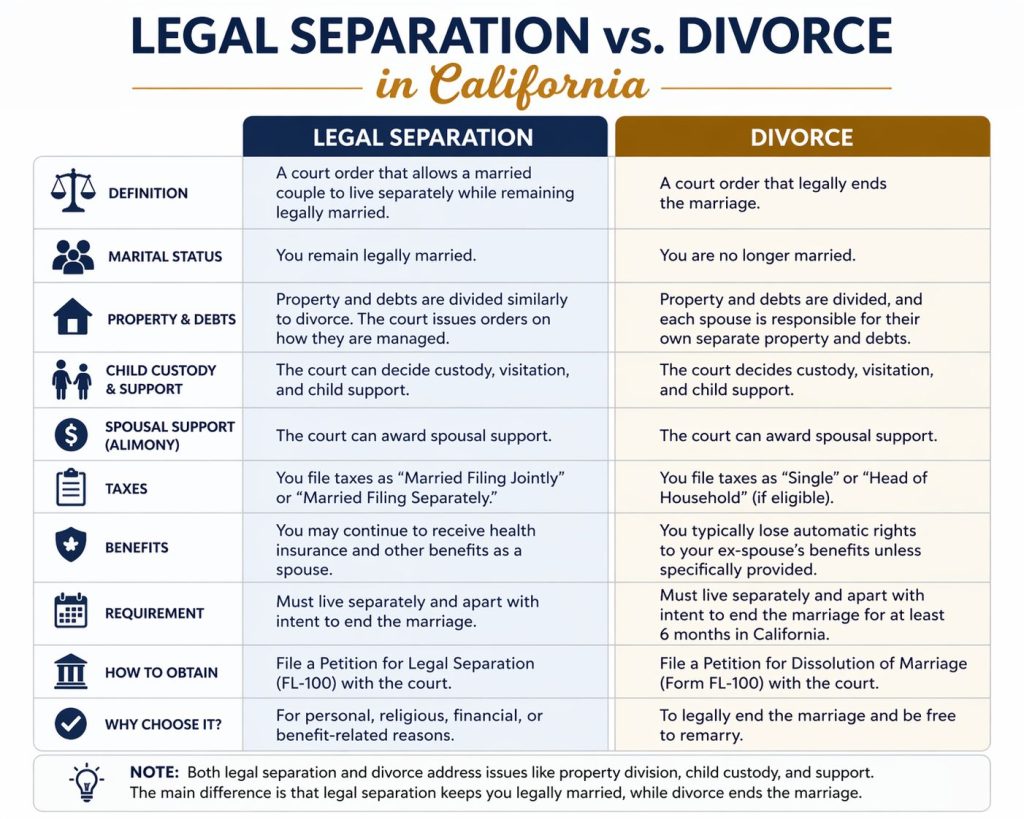
Comparison Summary: At a Glance
| Feature | Divorce | Legal Separation |
| Marital Status | Single / Unmarried | Still Legally Married |
| Residency Requirement | 6 Months in CA | None |
| Waiting Period | Mandatory 6 Months | None |
| Right to Remarry | Yes | No |
| Health Insurance | Usually Terminated | Often Retained |
| Asset Division | 50/50 Community Property | 50/50 Community Property |
Choosing Your Path
The choice between legal separation and divorce is not just a matter of “ending a relationship”—it is a strategic financial decision.
- Choose Legal Separation if you need to keep medical benefits, have religious objections to divorce, or are waiting to meet residency requirements.
- Choose Divorce if you want a total clean break, the freedom to remarry, and no longer want any legal ties to your former partner.
At WeCan Legal APC, we specialize in helping California families navigate these complex choices. We understand that your home, your retirement, and your children are your top priorities. Contact us today for a consultation. Let us help you protect your assets and build a stable foundation for your new chapter.
Need help with a family law matter?
Talk to WeCan Legal APC — free, confidential, no obligation.
Frequently Asked Questions
Q1: Can I convert my legal separation into a divorce later? +
Yes. If your circumstances change or you decide you want to remarry, you can file a motion to convert the proceeding into a dissolution of marriage. This is very common in California.
Does legal separation cost less than divorce? +
Generally, no. The legal fees and court filing fees are nearly identical because the work required—dividing assets, setting custody, and calculating support—is exactly the same.
Can my spouse stop me from getting a legal separation? +
In California, if one spouse files for legal separation and the other spouse files for divorce (dissolution), the court will usually grant the divorce. It takes two people to stay in a marriage (or a separation), but only one to end it via divorce.
Will I be responsible for my spouse's debt after we legally separate? +
No. Once the legal separation is filed and the “date of separation” is established, any new debt acquired by your spouse is their separate responsibility. However, you are still 50% responsible for “community debt” acquired during the marriage.
What happens to my pension or 401k? +
Retirement accounts are community property. A “Qualified Domestic Relations Order” (QDRO) is typically used in both divorce and separation to divide these accounts without triggering early withdrawal penalties.